Giving Tuesday: Trends, Best Practices, and Takeaways
Giving Tuesday. What’s not to love?
As conscientious citizens, it’s a special day where we collectively step up to support the causes we believe in.
As frenzied fundraisers, it’s an entire week where we collectively hold our breath, launch campaigns, and wait for the deluge of donations.
And every year, just when we think we’ve figured out the formula, donor behavior reminds us that nothing is static in the digital age.
This time around, we got a picture of giving that was less of an orchestrated greeting card moment and more of a glorious, messy, grassroots party. We saw the “giving week” stretch even further, we saw our perennial channel favorites mature into reliable workhorses, and, most surprisingly, we saw gift volume increase for the first time in years. If you thought you knew what was driving year-end revenue, think again.It’s time to unpack the drama, the data, and the delight on one of the more dynamic Giving Tuesdays we’ve seen yet. Let’s dive in…
Overall performance: Growth, distributed differently
Across programs, revenue trends were largely positive, but not uniformly so. Email and paid media were the strongest performers, each growing +12% YoY, while SMS jumped +14%, continuing its trajectory as a reliable, high-intent channel. Paid media also saw impressive growth (more on that in a moment) while organic web revenue dropped -5%, a continuation of the decline in organic traffic that we’ve observed throughout 2025.
One of the most notable trends this year is the reversal of established donor participation patterns. Beginning in the pandemic, we saw fewer gifts but higher-value contributions, driven largely by mid-level and major donors. This year, the opposite happened.
Giving Tuesday revenue grew YoY across digital channels, with both email and SMS increasing by double-digit percentages, driven by higher donation volume.
With revenue and donation volume increasing, the average gift did see some decline. Whether this shift reflects some cautiousness from larger donors or just greater grassroots response to growing community needs, the takeaway for nonprofits should be encouraging: Donor motivation is strong, and community participation may be broadening, but the distribution of giving power is changing.
Giving Tuesday is no longer a sprint
This year, Giving Tuesday continued its shift from a one-day event to a multi-week giving period. Organizations launched campaigns earlier, and donor behavior followed. Many supporters made their gifts days (or even weeks) before Giving Tuesday. On average, organizations saw October and November fundraising results outpacing last year’s by 18% amid increased advertising and outreach.
This aligns with what we’re seeing across digital channels:
- Paid teams are running longer, lower-friction campaigns.
- Email appeals stretch earlier into November.
- Donors convert when a reminder hits, not necessarily on the “big day.”
For organizations evaluating Giving Tuesday’s holistic impact, this means broadening the measurement window to understand donor behavior. The real story is in the ramp-up and tail, not just in the 24-hour total. And this is a good thing – more bites at the apple and less reliance on a single day.
Paid media: The clear standout
Paid media was the most consistent and reliable driver of growth for Blue State clients.
Organizations that invested strategically in paid media, using video, display, and social ads to create awareness and demand, and then leaned into paid search to “catch” high-intent traffic, saw strong returns. Paid search is a “brand insurance policy,” ensuring nonprofits show up where it matters most: in the moment donors are ready to act.
For several clients, paid compensated for soft organic traffic, making it a stabilizing force in addition to an acquisition lever. Flexible budgets and readiness to shift dollars quickly proved critical.
The broader picture is that Giving Tuesday heavily rewards organizations with strong paid infrastructure, clear conversion paths, eye-catching creative, cross-channel coordination, and the resources to scale spend when they see traction.
SMS: Steady growth in revenue and value
This year, SMS showed 14% YoY growth in revenue on average across organizations. While this is slower than the 110% YoY growth we saw in Giving Tuesday 2024, it reflects a maturing channel: SMS adoption is spreading, and supporters are getting comfortable responding to SMS, but not all organizations are taking full advantage of its potential.
SMS shines in urgent or high-priority moments, including emergencies or time-sensitive campaigns, because it lands directly on a donor’s personal device. That said, it’s a channel that demands care — audiences may feel their phone numbers are more personal than email, and overuse or misuse can lead to churn or donor fatigue.
Organizations should approach SMS thoughtfully: test message language, experiment with MMS to engage visually, monitor churn rates, and optimize frequency. Done right, SMS remains a highly responsive and efficient fundraising tool, complementing email and paid channels without overburdening donors during the competitive giving season.
Email: Bucking the trend
Many reports and conference sessions over the last couple of years have pushed the narrative that “email is declining”. This talking point doesn’t hold up as email saw strong year-over-year revenue growth for many organizations. This is a shift from prior years, though we did not see growth across the board.
The difference between strong and weak email performance came down to list health, segmentation discipline, and deliverability. Organizations that invest in exciting, varied creative, and email infrastructure — warming domains, tightening segmentation, cleaning lists, and maintaining brand stability — posted impressive gains.
Web: Reduced organic traffic and revenue
One of the clearest trends this year was a drop in organic search traffic, even on Giving Tuesday. Organic web revenue saw a sharp decline this year, with Giving Tuesday site traffic falling 36% and the share of traffic from organic search dropping 12 points versus 2024.
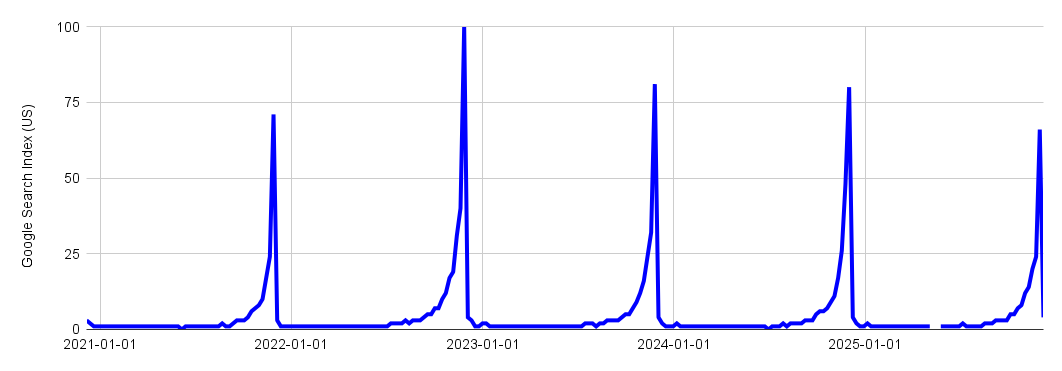
Why the drop? Several converging factors, including the rise of AI Overviews, LLMs, and zero-click results on search engines (see our research report). Additionally, we’ve seen Google search volume for “Giving Tuesday” is trailing prior years after search interest peaked in 2022.
In addition to fewer visits from organic search, we’re also seeing small but notable increases in traffic from AI chat-based platforms. While the volume remains relatively low, this growing traffic source reinforces that donors are finding information about organizations (and making donation decisions) off of the core website.
Creative takeaways
Celebrity moments still break the internet
Celebrity involvement remains one of the most reliable ways to break through the inbox and newsfeed clutter. Sometimes all it takes is a famous face (or voice!) to stop the scroll.
We saw this dynamic play out across organizations and sectors: a single photo in a Giving Tuesday email or a quick cameo can slice through inbox fatigue and add instant urgency.

This year, we saw a number of organizations feature celebrities in their Giving Tuesday campaigns. For Save the Children US, Meghan Trainor absolutely stole the show and helped propel the campaign to new heights. We recognize that not every organization has talent on speed dial, but for those who do, even a light-touch endorsement at a moment like Giving Tuesday.
Short, scrappy, and seriously effective
In an inbox jam-packed with graphics, animations, and more of everything, some of the biggest winners on Giving Tuesday were simpler emails: quick lift notes, tiny reminders, straight-to-the-point “quick asks.” Paired with the splashier moments, these formats packed a serious punch for 9/11 Memorial & Museum and Fountain House, among others.
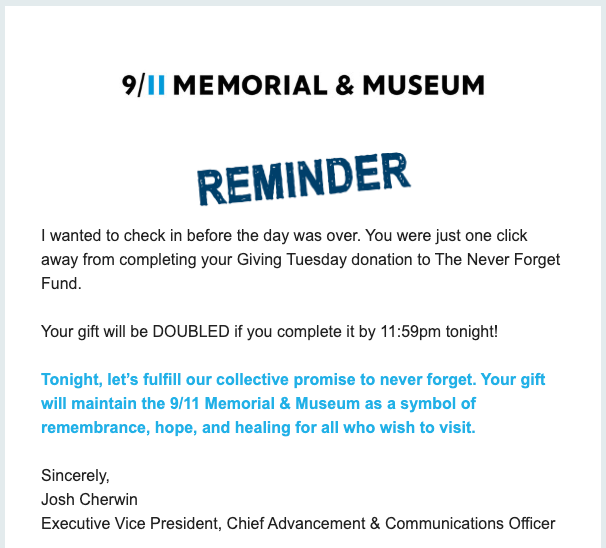
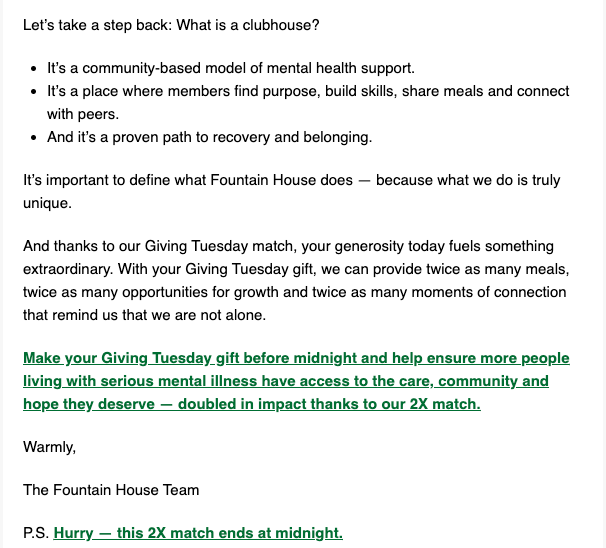
The takeaway? Sometimes less really is more. Emails that are short, low-friction and feature personal touches catch donors who don’t have time to scroll, and add up in a big way. As campaign duration and email volume increase, these lean emails aren’t just nice-to-haves – they’re essential for steady, incremental revenue – on Giving Tuesday and other large fundraising moments.
If it works, work it:
The tried-and-true fundraising tactics came through – again, and again, and yep, again. Some things in life are just reliable, right?
Supporter records, match upgrades, countdown clocks, and merch drops all hit exactly where we expected: straight out of the park. These classics keep winning because they tap into the fundamentals that actually get donors to act — urgency, identity, and that warm sense of belonging. If it’s not broke… don’t even think about fixing it!



What this all means for nonprofits and year-end fundraising
Giving Tuesday 2025 wasn’t uniformly strong or weak, but it was unmistakably dynamic – and shows us donors are present and ready to give. The next era of Giving Tuesday belongs to teams ready to plan smarter, pivot faster, and think much bigger than a single day.