Worlds Apart (Winter Appeal)
UK for UNHCR + Blue State
When the pandemic hit in March 2020, we knew we had to act quickly to ensure that our client UK for UNHCR was still able to continue raising money to support refugees.
And while emotions and uncertainty were prevailing in every article, social feed and broadcast channel — we quickly decided the best course of action was to counteract this uncertainty and use available data to give us a clearer steer of what would work best during this unique moment.
Knowing that human connection and emotion is key to helping our audiences realise they can and should make a difference to the life of a refugee. We started looking at data relevant to this key point and through social listening and monitoring on tools like Brandwatch we started to see synergies emerge regarding people in the UK coping with the pandemic in parallel with the voices of refugees fleeing for safety.
When will I see my family?
I worry about my elderly parents.
I miss my friends.
These data driven ‘truths’ became the core concept behind our campaign — Worlds Apart. Where we let the contextual moments from the pandemic sit literally between Brits and displaced refugees — side by side. Bringing together the faces of the UK public alongside displaced communities to show that this was a situation both audiences were facing (and could hopefully overcome) together.
But the data did not just inspire the creative, it also fuelled the identification of audiences we could target and informed messages that would encourage donations.
Our conversation monitor, designed and built in Brandwatch Consumer Insights, listened to UK audiences and allowed us to understand moments inspired from the struggle to further bring the UK public and refugees together — these real insights from across the nation helped create content across Facebook, Google Search, Instagram and digital display.
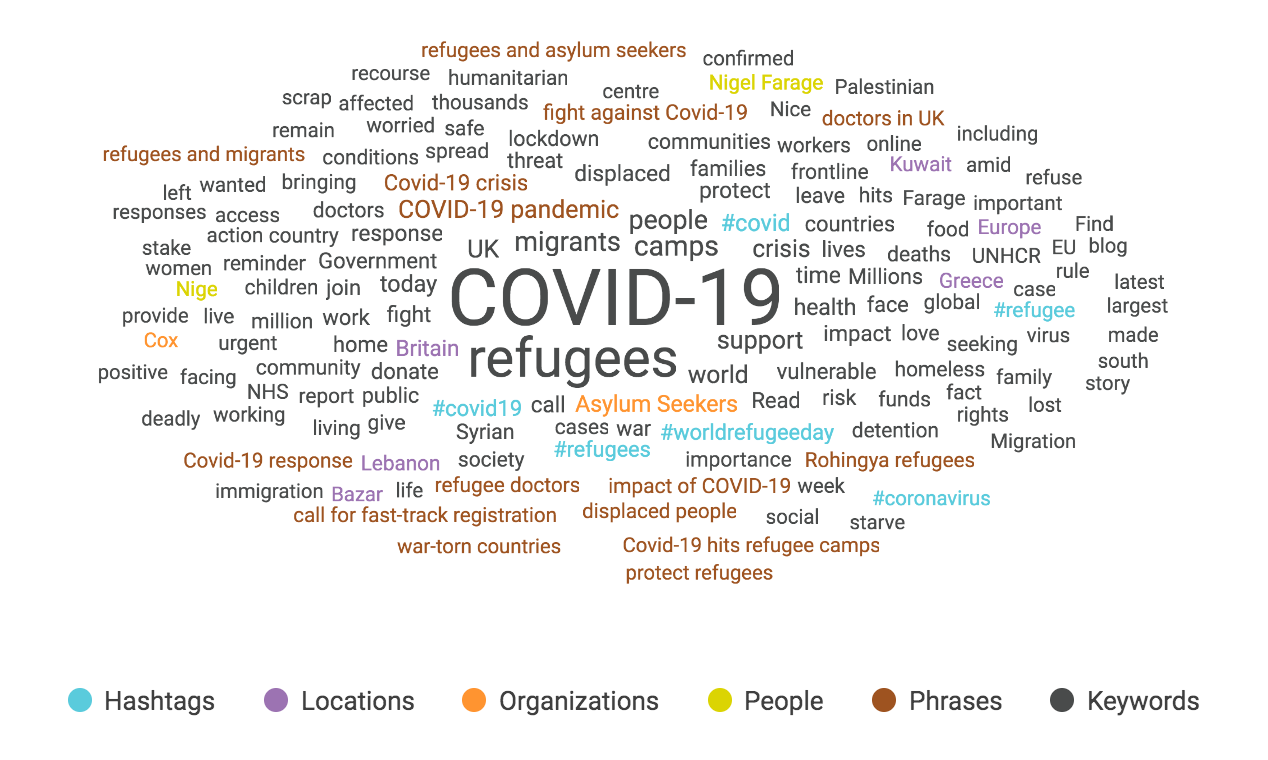
And the integration between data and creativity didn’t just stop there. As we needed to be in sync with public awareness regarding news about refugees, we set up social listening monitors to detect and alert our creative team to public conversations about relevant issues. So, when our monitors picked up an outcry over the lost lives of those attempting to cross the Mediterranean safely. We quickly pivoted our campaign creative to align to imagery shown in the news, tapping into the national conversation and improving support for refugees.
By using UNHCR’s existing data we were able to analyse our audience base and understand the motivations behind their engagement with the brand. Enabling us to broaden our targeting and appeal to a wider pool of prospects. Specifically, we could identify that people who spent time reading news articles and who cared about international news had a higher propensity to donate.
By then testing these segments against our smaller, core audience groups illustrated the opportunity to scale up activity by layering insight over much larger audiences. To give perspective, these new audience segments drove 364% more online donations than an existing core audience segment, whilst still hitting the target returns.
To further understand the mindset and behaviour of our prospective donors, we placed emphasis on testing donation price points within our advertising copy. Looking to gather insight into the ‘ask’ that would drive a positive ROAS, as well as scalable donation volumes. When testing three price points against each other, the winning variant drove 92% of the total volume of donations, at an ROAS 61% higher than the losing variant. This clear outcome enabled us to quickly optimise this element of copy across the rest of the campaign.
Analysing the average online donation amount per audience segment enabled us to plot the long term value of each against the cost of reaching them and ensure we are spending efficiently, thus incrementally optimising ROAS over time. This insight feeds directly into future creative production, with increasing data enabling us to ensure that any assets are created with the target audience at the forefront of each element.
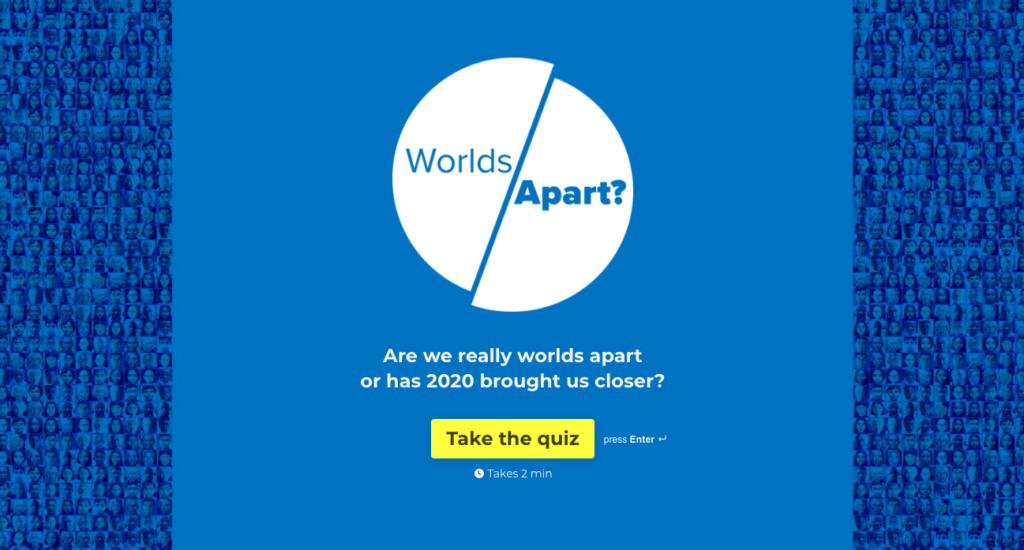
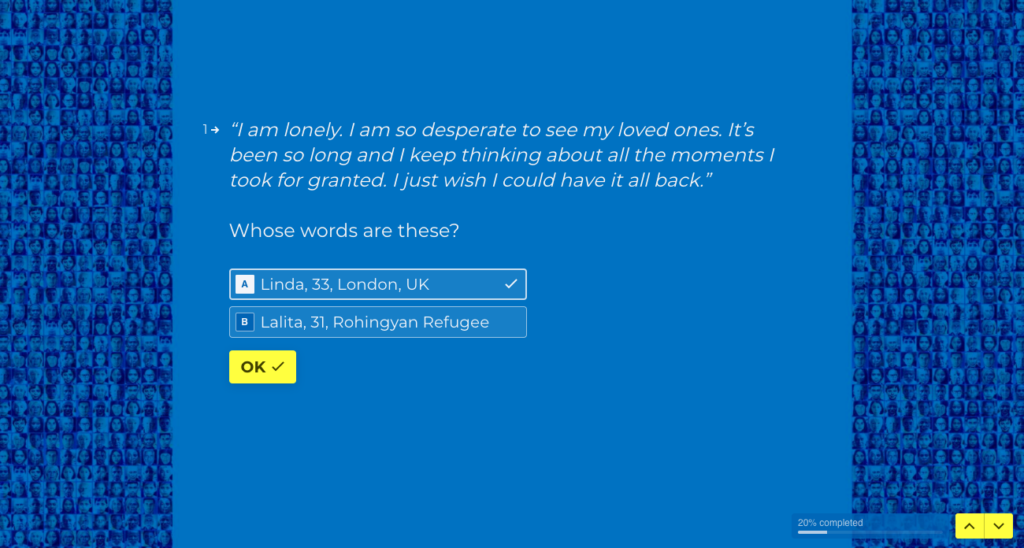
Once audiences had already donated — we then used social proofs collated through a survey to encourage further engagement. An interactive digital experience invited those already engaged; to guess if statements we had collected were from audiences in the UK or from refugees themselves; highlighting that the differences between ourselves and refugees and how we feel in certain situations were not as different as we might think.
The results of this powerful combination of data driven creative, alongside rigorous testing and optimisation of every step in the journey, from ad to thank you page, resulted in 2020 raising more online than the previous three years combined. Providing essential services and supplies to thousands of refugees worldwide.